


We often mistakenly think of the mortar between bricks as nothing more than aesthetic glue. In reality, it acts as a cushion that absorbs the building’s natural movements while creating a weather-resistant barrier that protects the structure from the elements. To fully understand the importance of this work, it is first important to look at what proper repointing involves.
What Is Repointing?
The joint is the space between bricks. Mortar, a mixture that bonds and protects masonry, fills that space. Over time, mortar can deteriorate and needs to be replaced. Repointing consists of removing deteriorated mortar and replacing it with new mortar that matches the original mortar’s characteristics. Depending on the condition of the façade, repointing may be performed on specific areas or across the entire façade.
Why Repoint?
Because if you wait, you are no longer looking at repointing, but partial or complete reconstruction.
Deteriorated joints can increase water penetration and contribute to freeze–thaw damage. Bulging or bowed masonry may indicate structural or anchorage problems and should be assessed before deciding on the appropriate repairs.
And the damage doesn’t stop there. Moisture that penetrates the walls can eventually reach insulation, wood framing and even the foundation. It can promote mold growth, affect indoor air quality and compromise the building’s structural integrity over time. A relatively simple intervention carried out early can prevent major and costly repairs, not to mention a potential decrease in property value.
Signs not to ignore: crumbling or recessed mortar joints, visible cracks, moisture stains on interior walls and bricks that are beginning to bulge outward.
A well-maintained brick façade can last for more than a century. When neglected, it can compromise the very building it is meant to protect. It is better to act early.
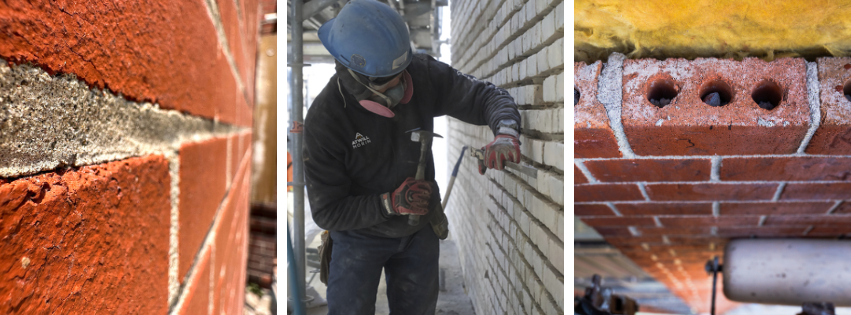
A Job for Specialists
Repointing is an expertise in its own right that involves several steps. Here’s why:
Inspection and Assessment
Before beginning any work, professionals, with the expertise of a mason, identify the cause of the deterioration and analyze the composition of the existing mortar. Mortar that is too hard, for example, can damage more fragile bricks. Every façade is unique.
Mortar Removal
The old mortar is removed manually using specialized tools, such as a grinder. The goal is to remove enough mortar without damaging the bricks. One mistake at this stage can mean having to replace the entire brick.
Cleaning and Preparation
Once the joints have been cleared, dust and debris are carefully vacuumed away at the source. This step is often underestimated, but it is crucial: clean joints ensure that the new mortar will bond properly and last longer.
Repointing in Layers
The mortar is applied in several successive layers, with each layer compacted to eliminate voids and ensure optimal density. The joint finish, including its profile and color, is adjusted to match the architectural style of the building.
Curing
The work does not end with the last joint. To develop its full strength, the mortar needs to cure evenly. Depending on weather conditions, it may need to be protected from direct sunlight, wind or freezing temperatures during the curing process. If it dries too quickly, the joint can crack before it has fully cured.
Challenges Only a Specialist Knows How to Anticipate
Inadequate Mortar
This is a common mistake made by contractors who are not specialized in masonry: using modern mortar on an older or heritage building. The result? Mortar that is harder than the brick itself. Over successive freeze-thaw cycles, the brick can crack and deteriorate instead of the joint. An experienced mason knows how to analyze the composition of the existing mortar and formulate a mix suited to each building.
Weather: A Factor We Can’t Control, but Can Manage
Mortar is vulnerable to outdoor conditions. Too much heat or wind can cause it to dry too quickly and crack. If it freezes, the entire job may have to be redone. Masons must therefore constantly adapt to the weather by covering scaffolding, dampening bricks before application and monitoring temperatures.
Joint Preparation: The Work You Don’t See
Before anything is applied, the joints must be cleared of old mortar, often to a depth equivalent to twice the joint thickness. This ratio provides enough depth for the new mortar to bond properly and develop strength over time. If the joint is too shallow, the new mortar can detach prematurely.
This preparation work often represents a significant portion of a mason’s work.
Key TakeawaysA damaged façade does not improve with time. A deteriorated mortar joint may seem minor, but the consequences can quickly become significant. Addressing the problem at the right time can prevent extensive repairs and help control costs. Atwill-Morin works with precision and expertise to protect the integrity and value of your building. Contact our experts today. |

