


In the field of structural reinforcement, several technologies can increase a building’s load-bearing capacity or improve its resistance to loads and seismic movements. Among the most widely used solutions are CFRP and FRCM. Although both rely on high-performance fibers, their composition, behavior, and applications differ considerably.
What is CFRP?
Carbon Fiber Reinforced Polymer, also known as CFRP, is a composite material made of carbon fibers embedded in an epoxy resin. This system is recognized for its exceptional mechanical strength and rigidity.
The principle involves bonding carbon plates, strips, or rods directly onto an existing structure, typically reinforced concrete. CFRP is commonly used to reinforce beams, slabs, walls, or bridges that require a significant increase in their load-bearing capacity.

Advantages of CFRP
CFRP offers several key advantages:
- Very high tensile strength
- Extremely thin and unobtrusive system
- Excellent long-term durability
- Very high structural rigidity
- Ideal solution for major reinforcement applications
Thanks to its outstanding strength-to-weight ratio, CFRP is widely used in demanding fields such as civil engineering, aerospace, and infrastructure.
What is FRCM?
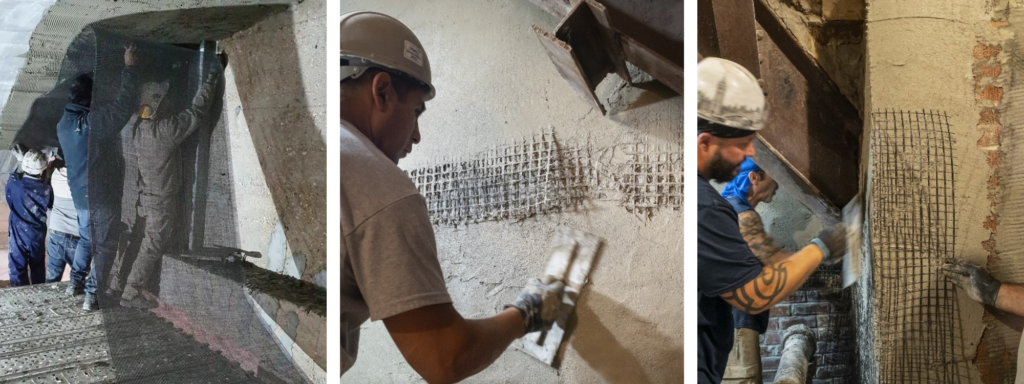
Fiber-Reinforced Cementitious Matrix, also known as FRCM, is a system composed of a cementitious mortar and a fiber mesh, typically made of carbon or glass.
Unlike CFRP, FRCM uses a mineral-based matrix rather than a polymer resin. The system is applied as a layer of reinforced mortar directly onto masonry or concrete.
This technology is particularly well-suited for heritage buildings, stone, and brick.
Advantages of FRCM
The main advantages of FRCM are:
- Compatible with historic masonry
- Allows the structure to breathe
- Good fire resistance
- Better tolerance for cracked or uneven surfaces
- More flexible in response to building movement
FRCM is often the preferred choice for rehabilitation projects, particularly in seismic zones where structures must be able to absorb movement without failure.
The Main Differences Between CFRP and FRCM
| System | Matrix | Fiber | Key Strengths |
|
CFRP (Carbon Fiber Reinforced Polymer) |
Epoxy (Polymer) |
Carbon only | Very high strength and stiffness, widely used for structural applications. |
| FRCM (Fiber-Reinforced Cementitious Matrix) | Cementitious Mortar | Textile Fibres (Carbon/Glass) | Masonry-compatible, breathable and enhanced fire and seismic performance. |
CFRP and FRCM are both high-performing structural reinforcement solutions, but designed for different contexts. While CFRP prioritizes maximum strength through carbon fibers and epoxy, FRCM offers a more compatible approach for existing buildings thanks to its breathable cementitious matrix and greater tolerance for movement.
Every building presents its own structural challenges. Trust Atwill-Morin’s expertise to identify the reinforcement solution best suited to your project.

