

Strengthen Rather Than Rebuild: A Sustainable Solution for Infrastructure
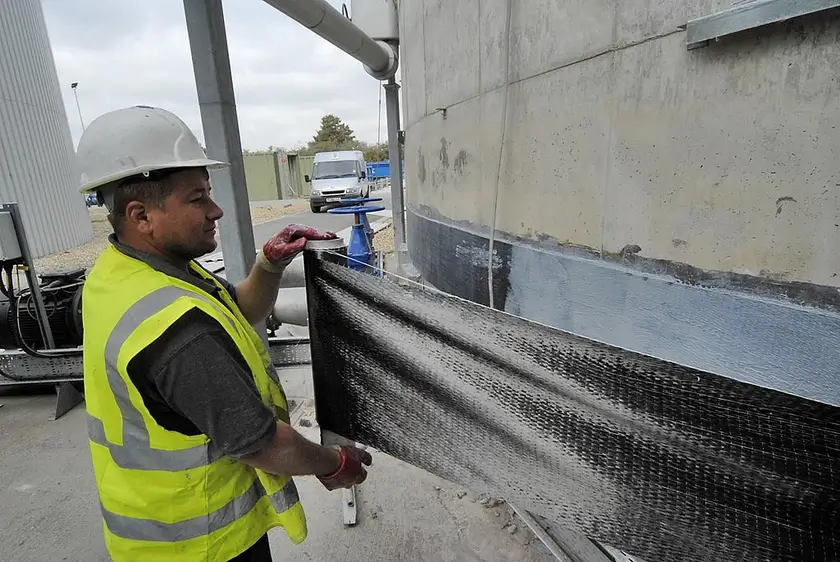
Bridges showing deflection, cracked beams, weakened columns, overloaded slabs… When facing these structural issues, the first reaction is often: “We need to demolish and rebuild.” Yet, there is a modern solution to strengthen your concrete civil works without destroying them or disrupting their use: reinforcement with Carbon Fiber Reinforced Polymer (CFRP).
This advanced technology, widely adopted in civil engineering worldwide, significantly increases the load-bearing capacity of existing structures, all while preserving their integrity and appearance. The result: substantial cost savings, shorter timelines, and infrastructure reinforced for decades to come.
What is CFRP and How Does It Work?
Carbon Fiber Reinforced Polymer (CFRP) or PRFC in French (Polymère Renforcé de Fibres de Carbone), is a high-performance composite material made of:
- Polymer matrix (typically epoxy)
- Carbon fibers (woven or unidirectional) embedded in this resin
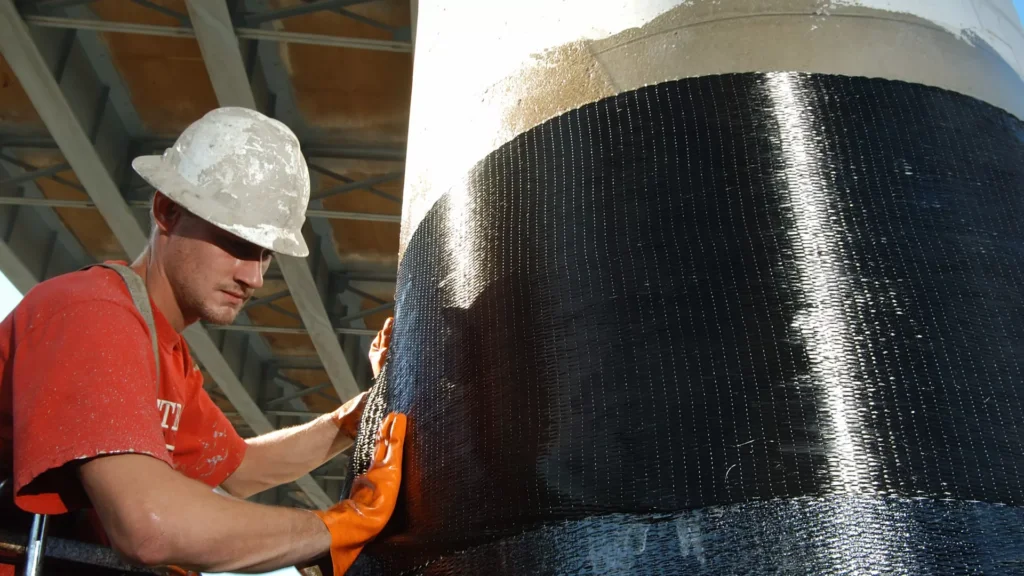
By combining these two elements, you get an extremely strong, lightweight, and durable material that can be applied to reinforced concrete, masonry, wood, or steel structures to restore or enhance their structural capacity.
Simply put, you reinforce a resin with carbon fibers to create a sort of structural plaster, or ultra-strong splint, that solidifies a weakened element.
The Benefits of CFRP for Structural Strengthening Projects
- Light Weight and Flexible Application
Unlike traditional methods that add weight and bulk, CFRP is extremely light. Fiber wraps are malleable and can conform to complex shapes, making it possible to strengthen columns, curved beams, or irregular surfaces with ease.
- Significant Increase in Strength
PRFC drastically improves:
- Flexural strength (beams, slabs)
- Shear strength (critical zones)
- Impact resistance and dynamic load capacity
- Overall structural stiffnes
- Cracks Prevention and Control
By reinforcing vulnerable areas, CFRP prevents new cracks from appearing and stabilizes existing ones, extending the lifespan of the structure.
- Corrosion Resistance
Unlike steel, carbon fibers do not rust. This is a major advantage for structures exposed to de-icing salts, marine humidity, or aggressive chemical environments.
- Minimal Visual Impact
The thickness added by CFRP is negligible (just a few millimeters). This is crucial for heritage building restoration or in spaces where aesthetics must be preserved.
- Versatility of Applications
CFRP can take many forms depending on requirements:
- Wraps and sheets
- Rods
- Strips
- Cords
This flexibility makes it possible to reinforce virtually any structural element: walls, slabs, beams, columns, openings, and more.
Comparison Table – External Reinforcement Types
| Material | Advantages | Disadvantages |
| Steel (Plates, Angles, Beams, Columns, Casings) | Low purchase cost Availability Known design methods |
Significant self-weight Difficult and lengthy installation Loss of clearance Large space required Fabrication and lifting equipment required High maintenance |
| Carbon Fiber Reinforced Polymer (CFRP) | Low self-weight Quick and cost-effective installation Clearance maintained Work in limited-access areas Low maintenance Corrosion-free |
Material solution with high technical requirements Installation by qualified labor |
Concrete Applications of CFRP in Civil Engineering
Beams and Slabs
Enhancing flexural capacity to support increased loads without the need for reconstruction. Ideal for buildings undergoing a change of use.
Example: In the transformation of a former long-term care facility into the Marie-Paule-Lanthier Birthing Center, new birthing tubs were installed. Since these water-filled tubs impose substantial loads on the existing structure, Atwill-Morin strengthened the beams with CFRP strips to ensure sufficient load-bearing capacity and long-term performance.
Bridges
CFRP is widely used to reinforce bridge decks and beams, extending service life and avoiding long-term closures, a frequent challenge for aging roadway infrastructure.
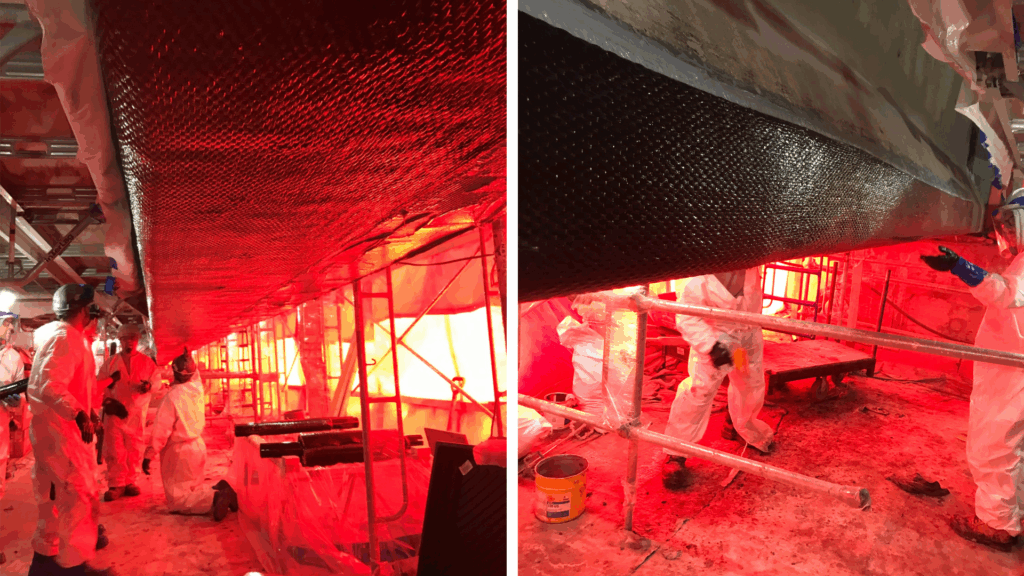
Example: Atwill-Morin participated in the construction of the new Île-aux-Tourtes highway bridge. The project included the erection of a new bridge as well as the rehabilitation and strengthening of the existing bridge, which needed to withstand abnormally high loads during the construction period. To reinforce the beams, vertical and horizontal strips were applied under the flanges to increase both flexural and tensile strength. Diagonal strips were also added to control shear, as cracks often form at an angle.
Pioneers in CRFP Repair in North America
Sometimes, existing CFRP reinforcement systems require repair, a demanding task that calls for specialized expertise, fully mastered by Atwill-Morin.
Example: During ongoing bridge work, two barge collisions damaged existing CRFP reinforcement. The Atwill-Morin team intervened to perform the necessary repairs. Apart from impact damage, structures reinforced with CRFP may sometimes be subjected to higher-than-anticipated loads. Atwill-Morin has the knowledge and skillset to restore the full performance of carbon fiber reinforcement.

Whether you are a public asset manager or a general contractor, our experts can assess your needs and deliver bespoke structural reinforcement solutions.
Contact Atwill-Morin today to schedule a consultation.